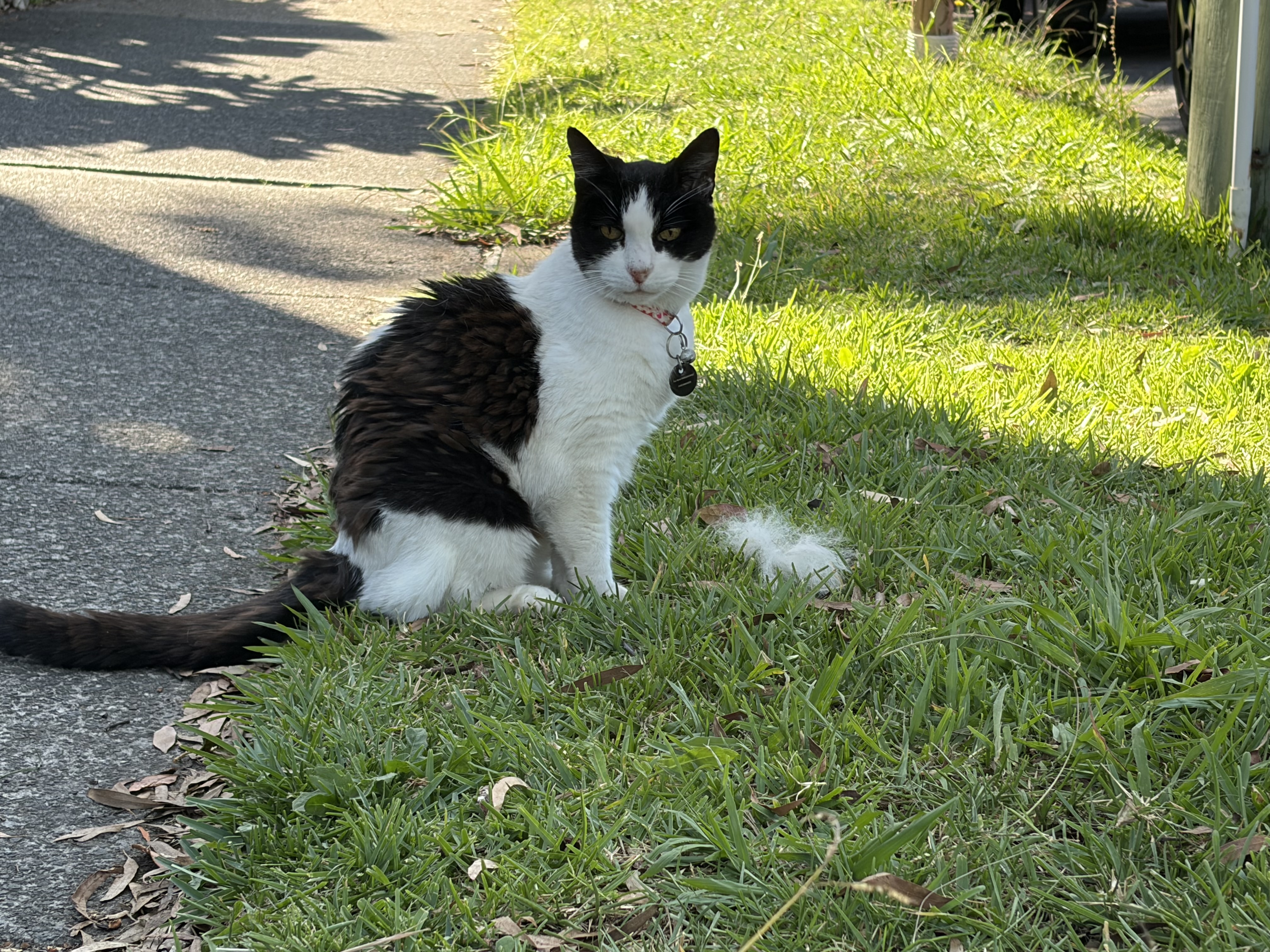
THE PROFESSION OF HERITAGE conservation puts 'significance' at the centre of what we do. Places that, as people say, 'are heritage', aren't necessarily important or valuable or beautiful or good, they're significant, which is a key distinction. Something, like a historical event or a social meaning, makes them significant, and we have elaborate rubrics and sets of criteria to checklist-test the values. At bottom, though, it's a fundamentally human and subjective thing: if someone asks 'is it heritage', the question implied is 'heritage to who'. It is my firm view that there is such a thing as cat significance.
We, Homo sapiens, are not the only users of places and not their only inhabitants, and not the only custodians of valuable spots. That much is obvious: the natural world is full of highly territorial creatures and species who have very elaborate pissing contests---I mean, literally, in urine---to create their own meaning and value to geographies and structures. Yes, a lot of this is purely functional and about preferential-competitive access to food (and thus outside the NSW criteria for heritage significance). Yes, we don't and can't know what it's like to be a bat, and their pinging and flapping life is an experience closed to us. True. But we are surrounded by a small number of species which, by domestication, really do share a mental and emotional register with us humans. Dogs and pigs and parrots are known to communicate emotionally with humans, and vice versa. Cats are territorial but they're also very social, and they arguably do take a limited part in the culture of human domestic life, just as we take a limited part in theirs. Why wouldn't cats also have an understanding of places that overlaps with the human?
There is an elderly cat in my street, Oscar, who lives in one particular house, but who treats the whole street as his own. In the afternoons when the sun warms the concrete fence and 'his' footpath he sits on it, and extracts the tribute of pats from passers-by that is his due. He is very tolerant to the buffeting pats of toddlers. He has no idea about subdivision patterns, historical use, changing class and demographics, much less about comparative rarity of the architecture. But he's a cat, and he obviously has preferences and experiences of architecture: on his fencepost he can surveil the street and be in turn scritched; in his cat bed on the verandah he's comfortable, underneath cars he's safe from birds. He has his favourite grassed lying-spots. He experiences the street and the road as a place of interest and danger, just like us, only he views it at an altitude of 20-30cm. He probably has a much more detailed interest in the architectural fabric of front gardens than any designer.
What would a cat heritage assessment look like?
Comments
There are currently no comments on this article.
Add a comment